Logistics

Digitise logistics processes. Improve efficiency and service quality.

Logistics companies need to coordinate transport, warehousing and customer requirements across numerous systems and partners. jambit develops and integrates software, data and platform solutions that connect processes, create transparency and enable new digital customer services – from architecture right through to live implementation.

  • TomTom
  • Car Connectivity Consortium
  • Webasto
  • Visteon
  • Magneti Marelli
  • CE4A
  • Digades
  • BMW
  • Mercedes-Benz
  • General Motors
  • Deutsche Bahn
  • VW
  • Audi
  • Renault
  • Fiat
  • MINI
  • Sixt
  • Continental
  • Alpine
  • TomTom
  • Car Connectivity Consortium
  • Webasto
  • Visteon
  • Magneti Marelli
  • CE4A
  • Digades
  • BMW
  • Mercedes-Benz
  • General Motors
  • Deutsche Bahn
  • VW
  • Audi
  • Renault
  • Fiat
  • MINI
  • Sixt
  • Continental
  • Alpine

Logistics in a time of change: Mastering cost-effectiveness and customer requirements through digitalisation

Logistics companies must manage complex transport, warehousing and handling processes reliably and cost-effectively. High cost and competitive pressures, tight staffing levels and increasing demands for speed, delivery quality and transparency are driving the need for efficient, digitally supported processes.

At the same time, clients’ expectations are changing. Industrial, retail and automotive companies require logistics partners who can integrate into their supply chains, meet specific requirements and reliably provide information on orders, goods movements and delivery status.

As a result, digital capability is increasingly becoming a competitive factor. Transport management systems (TMS), warehouse management systems (WMS), ERP applications, telematics solutions and customer platforms must exchange information and interact seamlessly across organisational boundaries. In established system landscapes, this often involves considerable effort.

Data, automation and AI open up additional opportunities for planning, scheduling and operational control. It is crucial to integrate this potential into existing processes and applications, thereby improving the cost-effectiveness and quality of logistics services.

Where the digitalisation of logistics companies is stalling

Different customer and partner systems make integration difficult

Logistics service providers work with numerous clients, transportation partners, and other stakeholders. Different interfaces, data formats, and process requirements make it difficult to ensure a seamless exchange of information.

New customer integrations and digital services often require customizations. This increases the effort required for integration and delays the technical implementation of new business requirements.

Fragmented data limits transparency and manageability

Order, vehicle, transport and warehouse data are stored in different applications. Information is not always up to date or available across all systems.

As a result, there is no consistent overview of operational processes, capacities and variances. Planning, customer service and management have to go to great lengths to collate information before they can make decisions or provide customers with reliable information.

Manual processes tie up operational capacity

Order processing, scheduling, documentation and status updates often involve repetitive manual tasks.

Media discontinuities and a lack of automation increase the workload and the likelihood of errors. Particularly in the case of distributed sites and when working with external partners, they make it difficult to respond quickly to changes in day-to-day operations.

Legacy logistics software is holding back new digital requirements

Existing TMS, WMS and ERP systems support core business processes. However, technical dependencies, bespoke customisations and limited interfaces often hinder their further development.

New customer portals, data applications or automated workflows must be compatible with these systems. Without a suitable integration and modernisation strategy, additional siloed solutions will emerge and maintenance costs will rise.

Automation and AI are not making their way into day-to-day operations

New applications for forecasting, planning or the automation of recurring tasks often demonstrate technical potential. However, their impact remains limited unless they are integrated into day-to-day processes and decision-making.

For productive use, data, business process requirements and existing systems must work together seamlessly. Otherwise, additional siloed solutions will emerge instead of providing tangible relief for operational teams.

Our projects: Digital fleets and connected processes

Mercedes PRO

Digital fleet management via the web and app.

Federal Office for Freight Transport

Distributed software system for mobile processes.

From customer order to proof of service: utilising information end-to-end

A logistics order involves numerous parties: the client, planning, the warehouse, transport partners and customer service. Each requires different information – from the original order through operational status updates to proof of the service provided.

If this information is available across system boundaries, handover processes can be simplified, discrepancies dealt with more quickly and customers kept reliably informed.


One order. Many stakeholders. A seamless flow of information.

This is how jambit takes responsibility for your logistics software

jambit combines software engineering with expertise in architecture, data, AI and platforms. We develop bespoke applications, integrate existing systems and modernise legacy software environments to meet the requirements of logistics processes.

Connecting logistics systems and partners digitally

We develop APIs, interfaces and integration architectures that connect existing transport, warehousing and business systems, as well as external applications.

In doing so, we take into account existing data structures, system dependencies and the requirements for a reliable exchange of information. In this way, we create a technical foundation upon which new functions and further integrations can be built.

Developing bespoke applications and operational workflows

jambit designs and develops business applications, mobile applications, portals and backend services. We translate business requirements into software architectures, user interfaces and integrated processes.

From requirements gathering through to implementation, we combine the perspectives of operational users with the technical requirements of existing systems.

Integrating data and AI into productive applications

We develop data architectures and integration solutions that make information from different systems usable. Building on this, we implement analytical applications, automated workflows and AI-powered functions.

In doing so, we take into account data quality, business control mechanisms and operational requirements to ensure that new functions can be reliably integrated into existing processes.

Case study: KPIxplain. With KPIxplain, jambit demonstrates how operational metrics can be more easily understood through an AI-powered dialogue. Using a dashboard for order picking processes as an example, business users can analyse data in a targeted manner, identify correlations and better understand deviations.

Modernising existing software and developing it further in the long term

jambit modernises legacy applications, develops new software components and designs cloud and platform architectures to ensure reliable operation.

We combine phased modernisation with security, scalability, maintainability and appropriate development and operational processes. This enables existing systems to be expanded in a targeted manner and new requirements to be implemented for the long term.

Digital targets along the logistics value chain

Digitalisation opens up opportunities for logistics companies to manage transport and warehousing more efficiently, engage customers more effectively and offer new digital services. Applications that solve specific operational tasks and improve the interaction between different systems are particularly relevant.

Digital fleet management and transport control

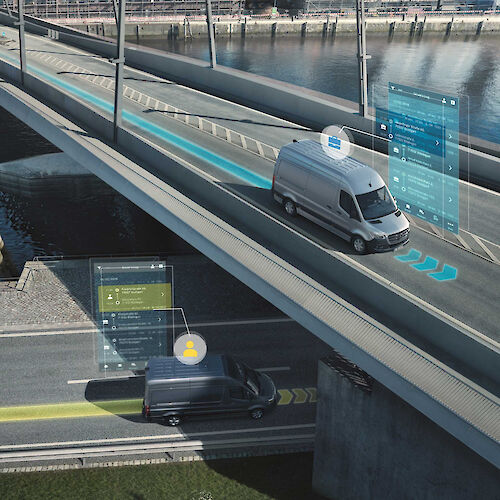
Digital fleet management applications provide vehicle, driver and order information for operational control. Functions for dispatch planning, vehicle monitoring, maintenance management and mobile communication facilitate the coordination of fleets and driver assignments.

The Mercedes PRO project demonstrates how such web and smartphone applications can be implemented.

Yard management and digital warehouse processes

Digital applications support the coordination of deliveries, time slots, vehicle movements and goods handling. Information from yard, warehouse and transport systems is made available to operational teams.

This makes it possible, for example, to better coordinate gate allocations and arrival times, reduce waiting times and coordinate handover between transport and warehouse in a more targeted manner.

Digital Customer and Partner Portals

Digital portals provide clients and business partners with direct access to logistics services. These include, for example, order entry, status enquiries, document exchange and self-service functions.

Integration with existing logistics systems makes relevant information immediately available and facilitates collaboration. New digital services can be added gradually.

Supply Chain Visibility and Traceability

Data from transport, warehousing and order processing provide a comprehensive overview of goods movements, process statuses and deviations.

Tracking, monitoring and analytics applications can consolidate information from various sources and prepare it for use by planning, customer service and management. This provides a better basis for monitoring processes, identifying bottlenecks and ensuring the traceability of delivery processes.

Intelligent Automation and Data-Driven Planning

Recurring tasks in order processing, document handling and operational coordination offer potential for digital workflows and AI-supported assistance systems.

Data-driven forecasts can support capacity and resource planning. Automated applications help to process information, prepare processing steps and reduce the workload on operational teams. Operational control remains integrated into the respective business processes.

Greater efficiency. Better control. Stronger customer relationships.

The business benefits of digital logistics solutions are evident in how reliably processes operate, how efficiently resources are utilised and how effectively customer requirements can be met

Less manual processing required

Lower process costs

Greater transparency for planning and scheduling

Faster onboarding of new customers and partners

Better customer services and new digital offerings

IT environments that can be expanded in the long term

Why logistics companies work with jambit

jambit brings a wealth of experience in digital fleet applications and distributed mobile work processes. Through our work with automotive and industrial companies, we also understand the technological requirements of key clients in the logistics sector. For your project, we therefore combine the perspective of operational users with the requirements for customer engagement and cross-organisational information exchange.

Working alongside your specialist and IT teams, we make technology-neutral decisions that are tailored to your transport, warehousing and service processes. In doing so, we take into account existing logistics systems as well as interfaces with clients and partners. We can either bolster your teams or take full responsibility for your software project – from consultancy through to long-term development.

What this means for you:

Frequently asked questions about digitalisation in the logistics sector

When is bespoke logistics software the right choice, and when is a standard solution sufficient?

Off-the-shelf software covers many established logistics processes. Custom development becomes particularly relevant when specific customer requirements, operational workflows or necessary integrations go beyond the existing functionality. jambit develops bespoke applications and components that complement existing systems and meet individual requirements.

Can existing TMS, WMS and ERP systems be upgraded without replacing them entirely?

Yes. Existing applications can often be enhanced using interfaces, APIs and additional software components. jambit analyses technical dependencies and develops integration and modernisation strategies that enable new functions to be introduced gradually whilst core business processes continue to run.

How can we go about digitising interconnected logistics processes?

A sensible starting point is a specific process with clear business benefits. To this end, the systems involved, data flows, dependencies and necessary integrations are examined. On this basis, prioritised implementation steps can be identified and further processes can be integrated step by step, without having to rebuild the entire system landscape from scratch.

What role does jambit play alongside in-house IT teams and existing software providers?

jambit complements existing business and IT expertise with software architecture, development, integration and modernisation. Depending on the project, we take responsibility for individual applications, integration components or more extensive software projects. In doing so, we collaborate with in-house teams and existing technology partners, whilst taking into account existing systems and areas of responsibility.

Let us help you further develop your logistics processes through digitalisation

Whether you want to integrate existing logistics systems, automate operational processes or develop new digital customer services: together, we’ll turn your requirements into a workable software solution.

Wilhelm Specht Sales Director

Wilhelm Specht

Sales Director Mobility

Let us help you further develop your logistics processes through digitalisation

* Pflichtfeld

Cookie Settings

This website uses cookies to personalize content and ads, provide social media features, and analyze website traffic. In addition, information about your use of the website is shared with social media, advertising, and analytics partners. These partners may merge the information with other data that you have provided to them or that they have collected from you using the services.

For more information, please refer to our privacy policy. There you can also change your cookie settings later on.
contact icon

Discuss logistics
projects