
Modern Cloud Environment for LBS Süd
 Open navigation
Working closely with our client, jambit has technically modernised the Collaboration Tool Suite and its core collaboration tools, migrating them to a highly available, scalable cloud-native architecture on Amazon Elastic Kubernetes Services (AWS EKS). This increases reliability and operational efficiency and enables faster deployments.
Client: Leading automotive manufacturer
Project: Collaboration Tool Suite for our client
Industry: Automotive
Services: Modernisation of the Collaboration Tool Suite on AWS EKS
Technologies: AWS EKS, Docker, Terraform, Terragrunt, GitHub, Grafana, Prometheus, Loki
As the central collaboration and communication service within the group, the Collaboration Tool Suite plays a crucial role in the day-to-day work of many teams. It brings together essential tools such as Jira, Confluence and Bitbucket, and supplements these with additional components such as Rocket.Chat and Seafile. This makes the Collaboration Tool Suite a key component for collaboration, information exchange and efficient coordination at our client’s organisation.
For a long time, the technical foundation of the platform was characterised by a single-instance operation of the Atlassian tools. This led to limitations such as a lack of redundancy, low reliability, restricted scalability, and downtime during maintenance windows and updates. Given the high usage and great importance of the platform, it was clear that the system needed to become more resilient and also be operated more efficiently and quickly.
Together with the client, jambit defined the goal of fundamentally modernising the architecture and setting up the platform to be highly available, scalable and cloud-native with multi-pod deployments on AWS EKS. In doing so, jambit increased availability and stability, accelerated deployments and reduced costs through dynamic scaling.
jambit has been supporting the Collaboration Tool Suite since 2020, providing operational and support services from first to third level, and was therefore involved in its strategic development from an early stage. The platform, originally developed as an internal product, has been continuously stabilised and functionally enhanced with our support. The migration to AWS EKS was a crucial step towards ensuring the platform’s future-proofing.
The focus of the implementation was on migrating the architecture to containerised multi-pod deployments and Kubernetes-based orchestration via Amazon EKS. This not only makes the platform significantly more scalable, but also reduces maintenance requirements and makes it considerably more resilient to failure, which represents a decisive advantage for a group-wide collaboration system.
In the implementation, jambit consistently relied on modern open-source tools and established technology standards. Selected AWS services were also utilised to optimally combine stability, security and automation. These included, among others, Docker for containerisation, Terraform and Terragrunt for Infrastructure as Code, and GitHub Actions for automated deployments. jambit implemented monitoring and observability using Grafana, Prometheus and Loki, thereby laying the foundation for robust, transparent and secure operations.
In June 2023, jambit successfully completed its migration to AWS EKS. Since then, the platform has been benefiting from the new architecture in production, proving to be stable, scalable and seamlessly integrable into the existing cloud and IT landscape of the Collaboration Tool Suite.
Collaboration in day-to-day operations has also proved to be a key success factor, as jambit has achieved a support rating of 4.8 out of 5 stars thanks to its ongoing support.
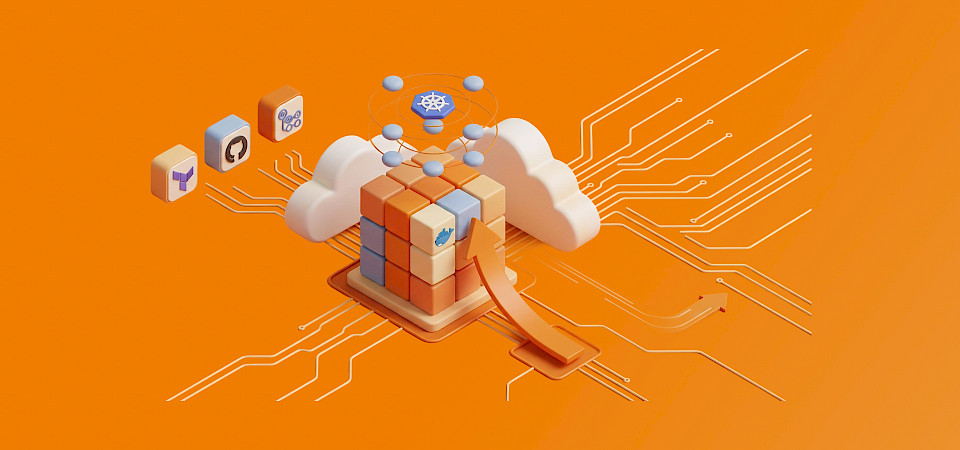
By modernising the Collaboration Tool Suite, jambit created a powerful and future-proof foundation that delivers clear added value to the customer.
The new EKS-based architecture ensures higher availability and significantly better scalability, even during periods of high concurrent usage. Similarly, the containerised structure and automated deployment processes enable faster deployments and rollbacks, which represents a clear advantage in terms of operations and updates.
Optimised testing and integrated DevSecOps mechanisms, such as security checks at container level, significantly improve quality assurance and enable more stable and secure further development of the platform. In addition, in-transit encryption of all applications helps to reliably meet high security standards within the corporate environment.
Last but not least, the new platform architecture also has a positive economic impact, as dynamic scaling allows resources to be deployed more effectively, thereby reducing costs. Furthermore, the team reduced first-level support requests, thereby easing the operational workload.

Contact us now